12V vs. 24V vs. 48V Solar Battery Wiring: How to Size Inverter Cables & Class-T Fuses Safely
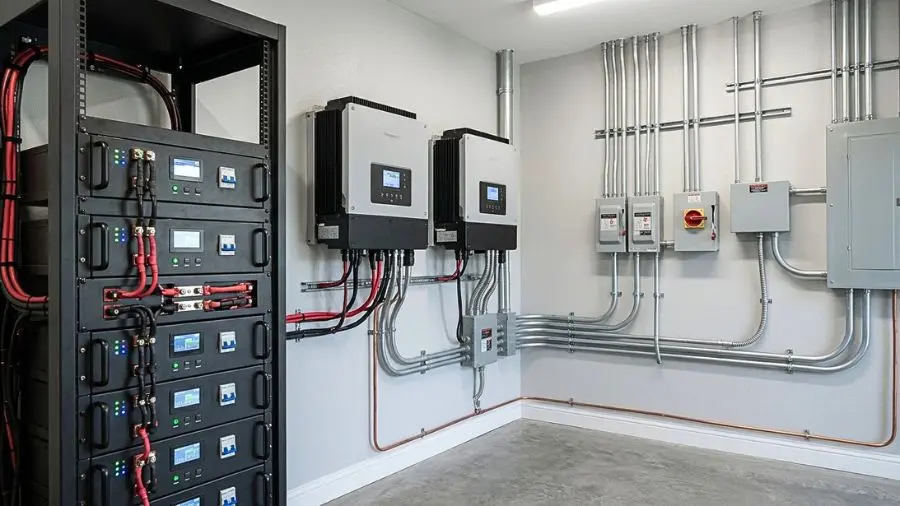
Doubling system voltage cuts current in half—and slashes percentage voltage drop by a factor of 4 for the same cable cross-section.
When building an off-grid solar system, the common shock for beginners is discovering just how thick the DC battery cables must be compared to standard household wiring.
1. The Low-Voltage Current Trap
A 3,000W inverter at 12V draws 284 Amps, requiring huge 4/0 AWG cables and 400A Class-T fuses. At 48V, that drops to 71 Amps, handled cleanly by 4 AWG copper.
⚡ Live Interactive Mini-Calculator: Voltage Drop & Joule Heat
Ohm's Law EngineTest conductor resistance (R = ρ·L/A) and see heat wasted in the cable before installation:
Joule Heat Loss in Cable: 157.5 Watts
Wire Size & Voltage Drop Calc
Stop testing wire gauges one by one! Automatically calculates commercial AWG & metric mm² sizes, breaker trip ratings (Ib ≤ In ≤ Iz), 8 conductor metals (Copper, Aluminum, Pure Nickel, Nichrome), AC Mains, 12V/24V/48V Solar, 40% Conduit Fill, and 40 Offline Guides.
✓ Free on Android (Google Play) • ✓ Works 100% Offline • ✓ 0% Crashes
Frequently Asked Technical Question
Why should you keep DC battery-to-inverter voltage drop under 1% to 2%?
In low-voltage DC systems (12V, 24V, 48V), even a 0.8V drop under heavy surge load can trigger the inverter's low-voltage disconnect (LVD) alarm prematurely and waste solar battery capacity as heat.