Solar Panels, MPPT Controllers & DC-DC Chargers: How to Never Run Out of Off-Grid Power
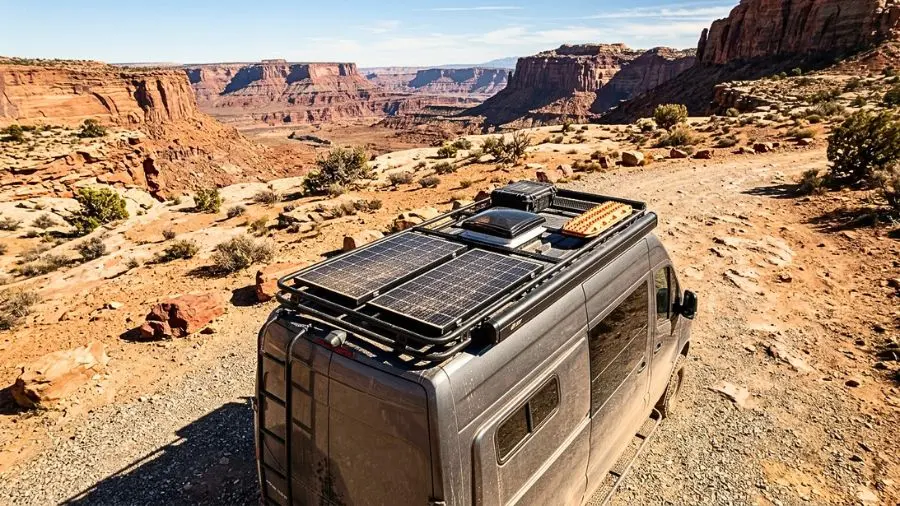
Overland field guide for Solar Panels, MPPT Controllers & DC-DC Chargers: How to Never Run Out of Off-Grid Power: Safe RV operation and equipment preservation.
Relying on a single source of electricity when camping off-grid is a recipe for anxiety as soon as three days of rain roll in. True energy independence in a motorhome or camper van comes from understanding how solar physics works in the real world—and why combining rooftop solar with a smart alternator charger makes your battery bank virtually inexhaustible.
First, understand the difference between nominal solar watts and real harvest. A 200W solar panel rated in a laboratory at 25°C under perpendicular midday sun will rarely produce 200W when mounted flat on a vehicle roof. Flat mounting reduces winter sun capture by 25% to 40%, and hot summer panels lose about 0.4% efficiency for every degree above 25°C. Even more critical is the 'garden hose effect' of partial shading: solar cells are wired in series strings, meaning that if a single tree branch, roof rack bar, or satellite dish casts a shadow over just 10% of a panel, the output of that entire panel can drop by 50% to 80%. Wiring two matched panels in parallel (or series-parallel with bypass diodes) and parking in full sun is worth more than buying extra panels and parking under trees.
Second, never pair modern solar panels with a cheap PWM (Pulse Width Modulation) controller. A solar panel operates at 18V to 40V, while your battery charges at ~14V. A PWM controller simply chops off the extra voltage and throws it away as lost heat. An MPPT (Maximum Power Point Tracking) controller acts as a DC-to-DC transformer: it takes the excess voltage and converts it into additional charging amps, boosting your daily energy harvest by up to 30%—especially on cloudy mornings and cold days when panel voltage is highest.
Finally, the ultimate redundancy secret is the DC-DC Alternator Charger (Booster). Modern vehicles (Euro 5/6 and late-model trucks) use 'smart alternators' that vary voltage and cannot charge an auxiliary leisure battery through a simple relay without either undercharging it or burning out the alternator when connected to hungry lithium batteries. Installing a 30A to 50A DC-DC Booster limits current to a safe level for your vehicle's alternator while delivering a precision multi-stage charge: just one hour of driving replenishes 400 to 600 Watt-hours of power, regardless of the weather outside.
Pro Tip: Keep your rooftop solar panels wiped clean of road dust and bird droppings—a single bird dropping on one cell acts like a permanent shadow that can cut panel output in half—and combine an MPPT solar controller with a DC-DC alternator booster for 100% weather-proof autonomy.
⚠️ Safety & Legal Notice: Educational guide only. Always cover solar panels with a blanket or cardboard before connecting or disconnecting wiring to prevent live DC arc flashes, and install inline fuses on both the solar array and battery lines.
🚐 Live RV Leveling & Absorption Fridge Safety Simulator
Dual-Axis LevelerCalculate exact leveling block heights under tires & protect your absorption fridge ammonia boiler:
Fridge Status: ✅ SAFE (<3.0° Tilt) — Ammonia refrigerant circulates freely by gravity.
RV & Home Leveler: Solar, HVAC
Park perfectly level without leaving your driver's seat. Voice-guided leveling calculates exact block heights under each tire based on your wheelbase. Includes 3° absorption fridge safety warning, off-grid LiFePO4/AGM solar calculator, and diesel heater altitude tuning.
✓ Free on Android (Google Play) • ✓ Works 100% Offline • ✓ 0% Crashes
Frequently Asked Technical Question
Why is Solar Panels, MPPT Controllers & DC-DC Chargers: How to Never Run Out of Off-Grid Power essential knowledge for every RV owner?
Proper leveling and climate management prevent thousands of dollars in ruined absorption fridges, fouled diesel burners, and dead batteries while boondocking off-grid.