The 3-Degree Rule: Why Parking Off-Level Permanently Destroys RV Absorption Fridges
Overland field guide for The 3-Degree Rule: Why Parking Off-Level Permanently Destroys RV Absorption Fridges: Safe RV operation and equipment preservation.
Few mistakes in the world of recreational vehicles are as silent and financially devastating as parking on a slope for the night and leaving a three-way absorption refrigerator running. Unlike a household compressor refrigerator—which uses an electric motor to forcefully pump refrigerant through its coils regardless of angle—an RV absorption unit operates in complete silence without a single moving part. Its entire cooling cycle relies on a delicate thermodynamic dance of ammonia, water, hydrogen gas, and pure gravity.
Inside the sealed steel tubes at the back of the fridge, a heat source (either a propane flame or a 120V/220V electric heating element) boils a solution of ammonia and water in the generator tube. The ammonia vapor rises to the top condenser, cools into a liquid, and then must flow downward through narrow, slightly angled evaporator tubes by gravity alone, absorbing heat from inside your food compartment before returning to the absorber tank at the bottom. Sodium chromate is added to the mixture as a corrosion inhibitor to protect the steel piping from within.
When your motorhome or travel trailer is tilted more than 3 degrees side-to-side (roll) or 5 to 6 degrees front-to-back (pitch) for more than an hour, gravity can no longer pull the liquid ammonia through the gently sloped coils. The liquid pools in the bends of the tubing while the boiler at the bottom runs dry. Worse still, the intense heat of the propane burner bakes the stagnant sodium chromate and ammonia solution until it crystallizes into a rock-hard yellow solid inside the steel pipe. Once this crystallization blocks the internal passage, the cooling unit is permanently ruined: the freezer warms up, a faint smell of ammonia may appear, and replacing the cooling unit costs between $1,500 and $3,000.
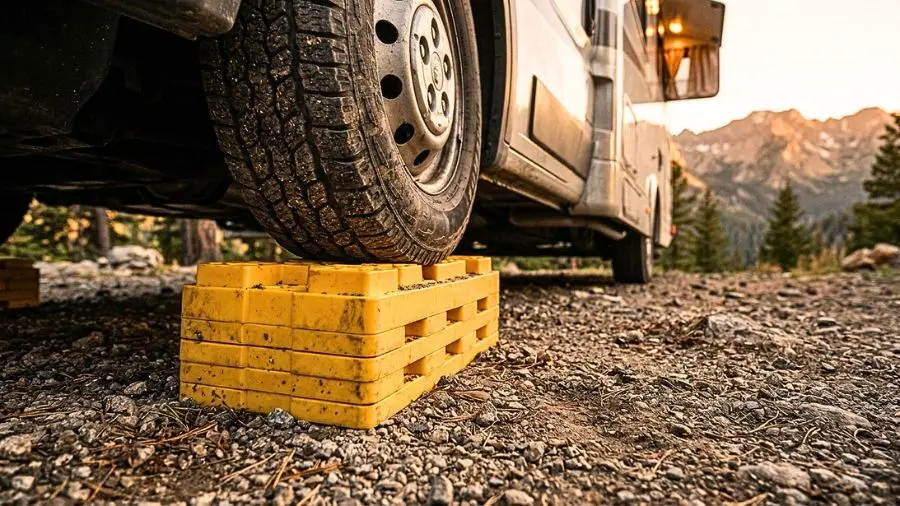
To prevent this catastrophe, always level your vehicle immediately upon arrival—before turning on the propane or AC cooling circuit. Use our built-in Smart Leveler to read the exact centimeter or inch lift required at each wheel, stack your modular leveling blocks in a gentle stepped pyramid so the tire climbs smoothly, and never lift two opposite diagonal corners with stabilizer jacks, which twists the chassis frame and cracks windshield seals. Remember that driving on a winding mountain road does not hurt the fridge because the liquid is constantly sloshing and moving; the danger only begins when the vehicle sits stationary off-level.
Pro Tip: Never operate an absorption refrigerator when stationary if your side-to-side tilt exceeds 3 degrees; if you must park on a steep street for a few hours, turn the fridge off and keep the door closed—a cold box will hold its temperature safely far longer than it takes to destroy a dry boiler.
⚠️ Safety & Legal Notice: This guide is for educational purposes. Never attempt to cut open or repair a sealed absorption cooling unit yourself, as pressurized anhydrous ammonia and hydrogen gas are toxic and flammable. Always consult a certified RV technician.
🚐 Live RV Leveling & Absorption Fridge Safety Simulator
Dual-Axis LevelerCalculate exact leveling block heights under tires & protect your absorption fridge ammonia boiler:
Fridge Status: ✅ SAFE (<3.0° Tilt) — Ammonia refrigerant circulates freely by gravity.
RV & Home Leveler: Solar, HVAC
Park perfectly level without leaving your driver's seat. Voice-guided leveling calculates exact block heights under each tire based on your wheelbase. Includes 3° absorption fridge safety warning, off-grid LiFePO4/AGM solar calculator, and diesel heater altitude tuning.
✓ Free on Android (Google Play) • ✓ Works 100% Offline • ✓ 0% Crashes
Frequently Asked Technical Question
Why is The 3-Degree Rule: Why Parking Off-Level Permanently Destroys RV Absorption Fridges essential knowledge for every RV owner?
Proper leveling and climate management prevent thousands of dollars in ruined absorption fridges, fouled diesel burners, and dead batteries while boondocking off-grid.