Master the 1/16'' Tape Measure: Read Fractions Like a Pro Framer
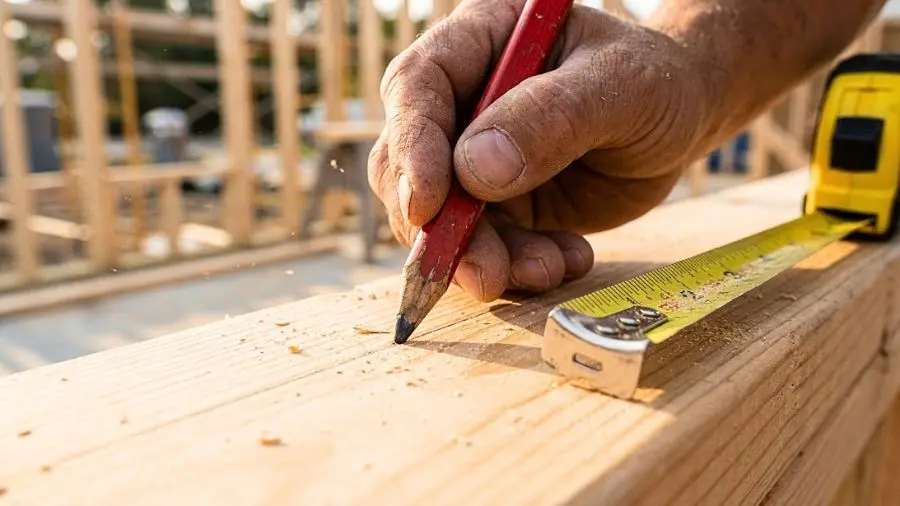
Field reference guide for Master the 1/16'' Tape Measure: Read Fractions Like a Pro Framer: Code-verified layout & precision cutting.
Walk onto any residential or commercial jobsite in the United States or Canada and you will notice that nobody calls out measurements in decimals like '14.3125 inches.' Instead, framers and finish carpenters speak the binary language of the imperial tape measure: feet, inches, and fractions of 1/2'', 1/4'', 1/8'', and 1/16''. If you ever struggled to read those tiny black lines quickly—or used a generic calculator that gave you a useless fraction like '2/3 of an inch'—understanding the visual hierarchy of the blade will change how you build forever.
Every single inch on a standard carpenter's tape measure is divided into 16 equal spaces (sixteenths) using lines of five different lengths. The longest line running all the way across the blade marks a whole inch (16/16''). The second-longest line right in the middle marks 1/2'' (8/16''). Halfway between the inch mark and the 1/2'' mark sit the third-longest lines: 1/4'' (4/16'') and 3/4'' (12/16''). Divide those quarters in half again and you get the fourth-longest lines: the eighths (1/8'', 3/8'', 5/8'', and 7/8''). Finally, the shortest tick marks between every eighth are the odd sixteenths (1/16'', 3/16'', 5/16'', 7/16'', 9/16'', 11/16'', 13/16'', and 15/16'').
Notice why denominators in carpentry are always powers of two (2, 4, 8, 16, 32): whenever a fraction has an even top number—such as 6/16'' or 12/16''—you divide both numbers by two until the top number is odd (6/16'' becomes 3/8'', and 12/16'' becomes 3/4''). That is why you will never hear a pro say 'twelve sixteenths.'
One more jobsite secret lives at the very tip of your tape: the sliding metal rivet hook. That metal hook is intentionally loose so it can slide back and forth by 1/16''—the exact thickness of the metal hook itself. When you hook the tape over the outside edge of a 2x4 board, the hook slides outward so the inside face of the hook is at true zero. When you push the tape against the inside of a window frame, the hook slides inward to subtract its own thickness automatically.
Pro Tip: Never waste time counting tiny lines under the sun: enter your dimensions in our calculator and look at the live Zoomed 1/16'' Tape Measure on screen—the red laser needle points to the exact tick mark you need to pencil on your board, alongside its exact millimeter equivalent.
⚠️ Safety & Legal Notice: This guide is for educational purposes. Always follow the golden rule of carpentry—measure twice on the physical workpiece before cutting once—and wear ANSI Z87.1 safety glasses when operating saws or snapping retracting steel tape blades.
🪚 Live Field Estimator: Common Rafter Pitch & IRC Stair Code
Trigonometric BlueprintTest roof rafters and stair stringers with instant building code validation:
Stair IRC Code Check: 9 Risers @ 7-3/4" — ✅ PASSES IRC R311.7.5 CODE (≤7-3/4")
Framing & Roof Calc: Tape 1/16
Job-site engineering instrument with dual units (US Imperial fractions ↔ Metric). Features visual 1/16" tape zoom with red needle, 1-tap fractions, voice readout on ladders, roof pitch & rafters (Common, Hip/Valley, Jack), IRC stair stringers, raked wall studs, and concrete cubic yards.
✓ Free on Android (Google Play) • ✓ Works 100% Offline • ✓ 0% Crashes
Frequently Asked Technical Question
What is the most critical mistake to avoid when calculating Master the 1/16'' Tape Measure: Read Fractions Like a Pro Framer?
The most common failure is decimal rounding errors on jobsites without checking building code minimums and deducting nominal board thicknesses before cutting.