12V RV Water Pump Rapid Pulsing: Sizing Accumulator Tanks & Calibrating Pressure Switches
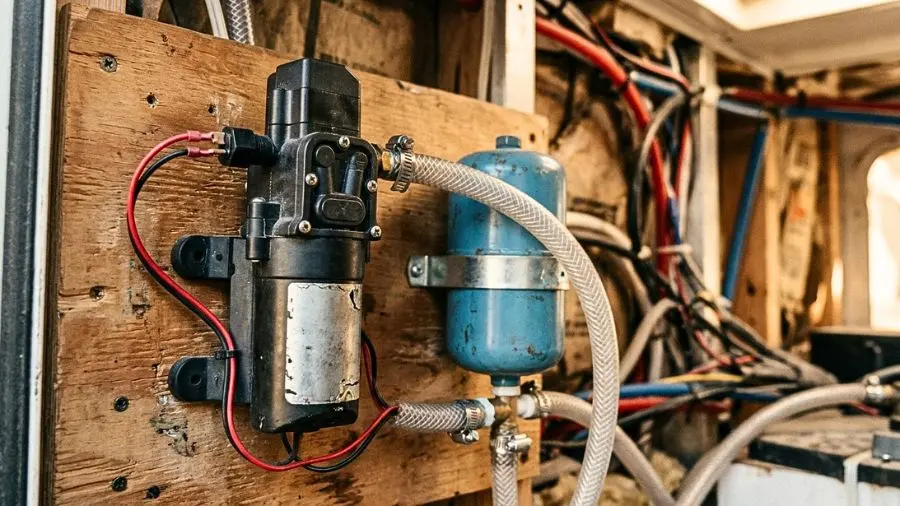
When a faucet is opened to a gentle stream, 12V diaphragm pumps chatter 5 times per second—an inline pressurized accumulator tank stops noise and preserves motor life.
Ask any camper owner about their biggest minor annoyance during a quiet night in the woods, and they will describe the same sound: you turn on the bathroom faucet to wash your hands or rinse a toothbrush, and beneath the floorboards, the 12V DC water pump erupts into a violent, rhythmic chatter—vibrating water lines against wooden cabinets like a pneumatic jackhammer. That rapid stuttering is called Pump Rapid Cycling (Chatter), and it is a symptom of hydraulic imbalance.
1. The Mechanics of the Positive Displacement Pump
Standard RV water pumps (such as Shurflo Revolution or Seaflo 3-chamber units) are Positive Displacement Diaphragm Pumps. Unlike centrifugal pumps that can spin against a closed valve without building infinite pressure, each stroke of a diaphragm pump forces an exact volume of water forward:
- Rated Flow: Typically delivers
3.0 GPM(11.3 LPM) at full open flow. - Shut-Off Pressure Switch: An internal microswitch calibrated to cut power to the 12V motor when line pressure reaches 45 to 55 PSI.
- Cut-In Threshold: Re-engages power when line pressure falls below approximately 30 to 40 PSI.
When you crack a faucet valve to a gentle stream (consuming only 0.5 GPM), the pump supplies 6 times more water than escapes. Line pressure hits 55 PSI in a fraction of a second, the switch snaps open, pressure drops instantly, the switch snaps shut, and the pump pulses 5 to 8 times per second.
2. The Cure: The Pressurized Accumulator Tank
Because water is a non-compressible fluid, rigid PEX piping has zero cushion to absorb pressure spikes. The professional solution is plumbing a Pressurized Accumulator Tank (typically 0.7 to 1.0 liter capacity) into the cold water line immediately downstream of the pump discharge:
Inside the steel or nylon accumulator tank is a flexible rubber bladder separating stored water from a pocket of pressurized air. Air is compressible. When the pump runs, water compresses the air cushion. When you open a faucet to a trickle, the expanding air cushion delivers a smooth, steady stream of water for several minutes with the electric pump completely OFF!
3. Pre-Charge Pressure Calibration Math
Here is where many DIY installations fail: you cannot simply take an accumulator tank out of the shipping box and bolt it in. You must calibrate its internal air bladder pressure using a standard Schrader tire gauge:
The Golden Calibration Rule: The accumulator air pre-charge must be set to exactly 2 to 3 PSI BELOW the water pump's cut-in pressure.
- If your pump turns ON at
30 PSIand OFF at50 PSI, calibrate the accumulator tank air bladder to exactly 27 to 28 PSI. - Measurement Procedure: You must relieve all water system pressure (turn off 12V pump, open all faucets) before reading or pumping air into the Schrader valve. If measured with water pressure in the lines, the tire gauge will show water line pressure, not air cushion pre-charge!
4. Tuning the Internal Bypass Screw
Modern high-end RV pumps feature an internal Bypass Valve controlled by a small Allen set screw on the center of the pump head. Turning this screw clockwise increases bypass pressure, allowing excess water to circulate internally from discharge to inlet at low flow rates, virtually eliminating low-flow cycling noise even without an accumulator tank.
Keep your entire camper build level, verify tank drain angles, and check solar roof inclinations with RV & Home Leveler: Solar, HVAC on your Android phone to ensure smooth water drainage and comfortable living off-grid.
🚐 Live RV Leveling & Absorption Fridge Safety Simulator
Dual-Axis LevelerCalculate exact leveling block heights under tires & protect your absorption fridge ammonia boiler:
Fridge Status: ✅ SAFE (<3.0° Tilt) — Ammonia refrigerant circulates freely by gravity.
RV & Home Leveler: Solar, HVAC
Park perfectly level without leaving your driver's seat. Voice-guided leveling calculates exact block heights under each tire based on your wheelbase. Includes 3° absorption fridge safety warning, off-grid LiFePO4/AGM solar calculator, and diesel heater altitude tuning.
✓ Free on Android (Google Play) • ✓ Works 100% Offline • ✓ 0% Crashes
Frequently Asked Technical Question
Why does an RV 12V fresh water pump rapidly cycle on and off (chatter) when a faucet is opened only partially?
RV fresh water pumps are positive-displacement diaphragm pumps designed to deliver roughly 3.0 to 3.5 gallons per minute (GPM) at 45 to 55 PSI. When you open a faucet partially (drawing only 0.5 GPM), the pump produces far more volume than the faucet can discharge. Pressure inside the closed PEX lines instantly spikes to the 55 PSI cut-off threshold, shutting the pump off. The pressure then instantly drops to the 40 PSI cut-in threshold, turning the pump on again. This cycle repeats multiple times per second (rapid pulsing / chatter), hammering pipe fittings and overheating the DC pump motor.