Campervan Insulation & Thermal Bridging: Armaflex vs. 3M Thinsulate vs. Fiberglass Traps
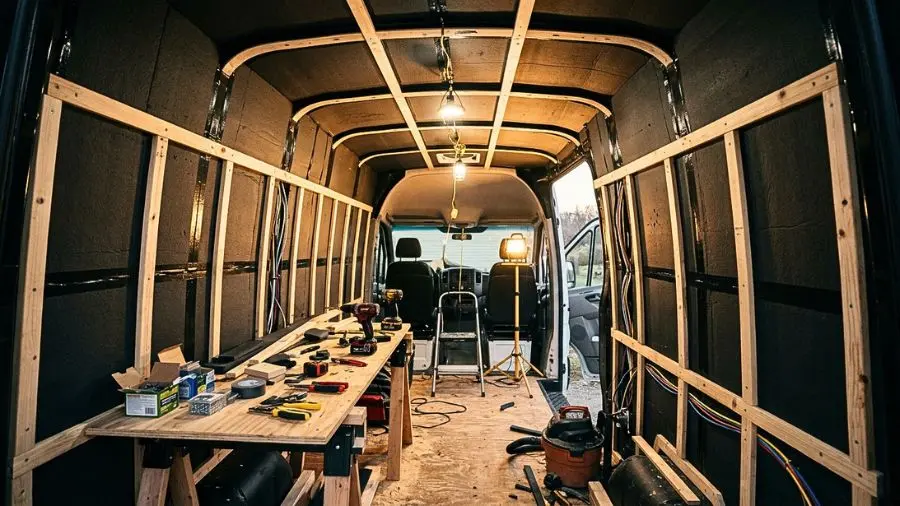
Steel van ribs act as massive thermal radiators—insulating cavity pockets while leaving metal ribs exposed causes condensation dripping and concealed body rust.
Step inside an uninsulated cargo van on a sunny 85°F (29°C) summer afternoon, and you are effectively stepping inside a convection oven: interior sheet metal temperatures easily exceed 130°F (55°C). Sleep in that same van on a 25°F (-4°C) winter night, and you awaken to ice forming on the walls and cold water dripping on your face from the ceiling ribs. Proper thermal insulation is what transforms a metal cargo shell into a habitable four-season camper.
1. The Automotive Sheet Metal Reality
A cargo van is an enclosed steel box with a thermal conductivity rating of roughly k ≈ 50 W/m·K—making steel a thermal super-conductor. Heat radiates straight through uninhibited. More critically, human occupancy produces massive moisture: two adults breathing and sleeping release approximately 1.5 to 2.0 liters of water vapor into the air every night.
If that moisture contacts freezing outer sheet metal, it condenses immediately into liquid water (dew point condensation). That liquid will either rot your plywood cabinetry, trigger toxic black mold behind walls, or rust the vehicle chassis from the inside out.
2. Why Fiberglass Batting Destroys Vans
Rookie builders often try to save money by stuffing yellow or pink residential fiberglass batting into van wall cavities. This is a fatal mistake. Fiberglass does not stop airflow. Moisture-laden interior air blows straight through the fibers, hits the cold steel wall, condenses, and soaks the batting like a wet sponge. Because vehicle cavities have zero gravity drainage, wet fiberglass slumps to the bottom, holding water permanently against sheet metal seams.
3. Armaflex vs. 3M Thinsulate: The Two Proven Standards
| Insulation Material | Vapor Permeability | Primary Advantage |
|---|---|---|
| Closed-Cell Elastomeric Foam (Armaflex / K-Flex) | Zero (μ ≥ 10,000 built-in vapor barrier) | Glued directly to sheet metal; impossible for air to get behind it; excellent vibration deadening. |
| 3M Thinsulate (SM600L) | Breathable hydrophobic fibers | Engineered specifically for automotive OE; absorbs zero water; compresses into tight cavities without losing R-value. |
4. Defeating Thermal Bridging on Metal Ribs
The single greatest insulation mistake is filling large panel cavities while leaving the structural Steel Ribs and Pillars exposed. Steel conducts heat 1,000 times faster than foam!
If you screw interior tongue-and-groove cedar or Baltic birch plywood directly into bare metal ribs, each rib acts as a giant radiator, sucking heat out of the living space and forming lines of black mold behind your paneling. Master builders decouple every metal rib by adhering 1/4-inch closed-cell foam tape or thin wood furring strips over the metal face before attaching interior wall cladding.
Maintaining correct interior slope, level reference, and checking solar panel angles on your camper roof is effortless with RV & Home Leveler: Solar, HVAC—calibrating zero-degree level references across all build stages.
🚐 Live RV Leveling & Absorption Fridge Safety Simulator
Dual-Axis LevelerCalculate exact leveling block heights under tires & protect your absorption fridge ammonia boiler:
Fridge Status: ✅ SAFE (<3.0° Tilt) — Ammonia refrigerant circulates freely by gravity.
RV & Home Leveler: Solar, HVAC
Park perfectly level without leaving your driver's seat. Voice-guided leveling calculates exact block heights under each tire based on your wheelbase. Includes 3° absorption fridge safety warning, off-grid LiFePO4/AGM solar calculator, and diesel heater altitude tuning.
✓ Free on Android (Google Play) • ✓ Works 100% Offline • ✓ 0% Crashes
Frequently Asked Technical Question
Why is standard residential fiberglass batting insulation prohibited in campervan and RV conversions?
Residential fiberglass insulation is air-permeable and hydrophobic. In a campervan, human breathing, cooking, and sleeping produce high indoor humidity. This warm, moist vapor easily migrates through fiberglass batting until it strikes the freezing exterior automotive sheet metal. The vapor instantly reaches its dew point and condenses into liquid water droplets. The fiberglass traps this liquid against the raw steel van walls, creating hidden black mold colonies and rusting through the vehicle body panels from the inside out.