The 1.35 Concrete Voids Compaction Trap & Why Extra Water Destroys Slab Strength
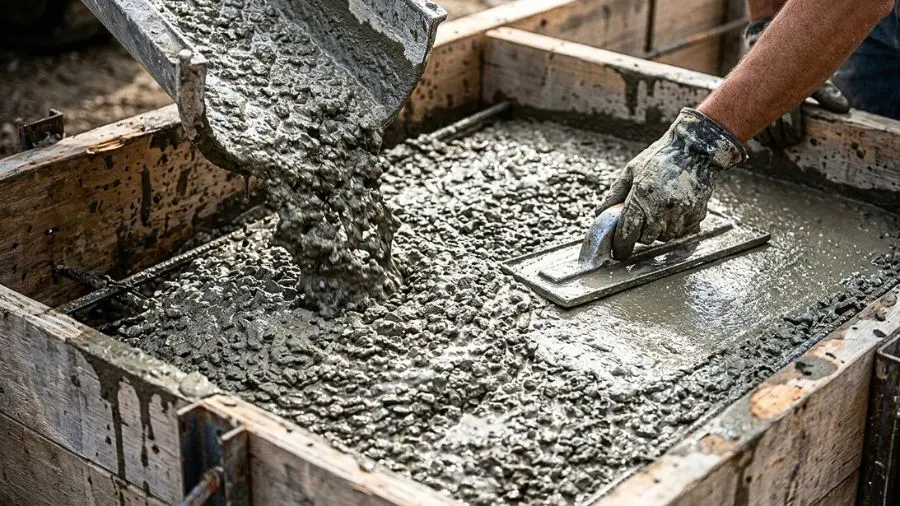
Mixing dry loose sand, crushed stone, and Portland cement shrinks ~35% in total physical volume as water washes fine paste deep inside stone air voids.
Ask any masonry crew mixing slabs, footings, or fence post bases from raw bulk stockpiles, and almost every novice suffers the exact same shock: "My footing math required exactly 1.0 cubic meter, I dumped 0.5m³ sand plus 0.5m³ stone plus 7 bags of cement into the mixer—and my forms still finished 6 inches short before dark!"
1. Solving the Missing Volume Puzzle: The 1.35 Compaction Multiplier
Dry crushed stone (3/4") sits loosely with nearly 40% hollow empty air trapped between stone edges. The moment water and Portland cement enter the drum, fine sand grains wash neatly inside empty pockets between larger stones. Your combined dry heaps pack tightly together, shrinking raw unmixed volume down by nearly 26% to 35%!
- When ordering pre-mixed ready-mix concrete trucks or pre-blended 80-lb bags, volume stays nearly 1:1 (only adding ~5–10% ground unevenness waste).
- When batching dry raw stone, sand, and loose Portland bags separately (
1:2:3or1:2:4mix), ALWAYS scale raw bulk aggregate purchases upward by the 1.35 Voids Compaction Factor!
2. Abrams' Law: Never "Splash a Little Water" to Make Raking Easier
When a ready-mix truck arrives looking stiff on a 90 °F afternoon, lazy finishers scream at the driver: "Add 15 gallons to the drum so it flows faster!" That convenience ruins structural concrete. Cement only needs roughly 0.25 to 0.40 lb of water per lb of cement chemically to hydrate into crystal strength. Excess "slush water" evaporates weeks later—leaving behind millions of microscopic capillary tunnels that slash slab strength from 4,000 PSI down to 2,200 PSI crumbling dust prone to freeze-thaw spalling.
Framing & Roof Calc: Tape 1/16 eliminates batch math nightmares automatically applying the 1.35 bulk aggregate factor vs. pre-mix bags, cubic yards, wheelbarrows, and water limits in one tap.
🪚 Live Field Estimator: Common Rafter Pitch & IRC Stair Code
Trigonometric BlueprintTest roof rafters and stair stringers with instant building code validation:
Stair IRC Code Check: 9 Risers @ 7-3/4" — ✅ PASSES IRC R311.7.5 CODE (≤7-3/4")
Framing & Roof Calc: Tape 1/16
Job-site engineering instrument with dual units (US Imperial fractions ↔ Metric). Features visual 1/16" tape zoom with red needle, 1-tap fractions, voice readout on ladders, roof pitch & rafters (Common, Hip/Valley, Jack), IRC stair stringers, raked wall studs, and concrete cubic yards.
✓ Free on Android (Google Play) • ✓ Works 100% Offline • ✓ 0% Crashes
Frequently Asked Technical Question
Why do builders multiply finished slab concrete volume by ~1.35 when ordering raw sand, stone, and cement separately?
Loose dry gravel contains huge empty air pockets (~35–40% void space). When mixed with water, cement paste and fine sand vanish directly inside the open cavities between big stones, shrinking total wet yield noticeably below the combined dry piles unless multiplied by a ~1.30–1.35 compaction shrinkage factor.