Jack Rafter Layout: How to Calculate Common Difference & Cut 45° Hip/Valley Cheek Bevels
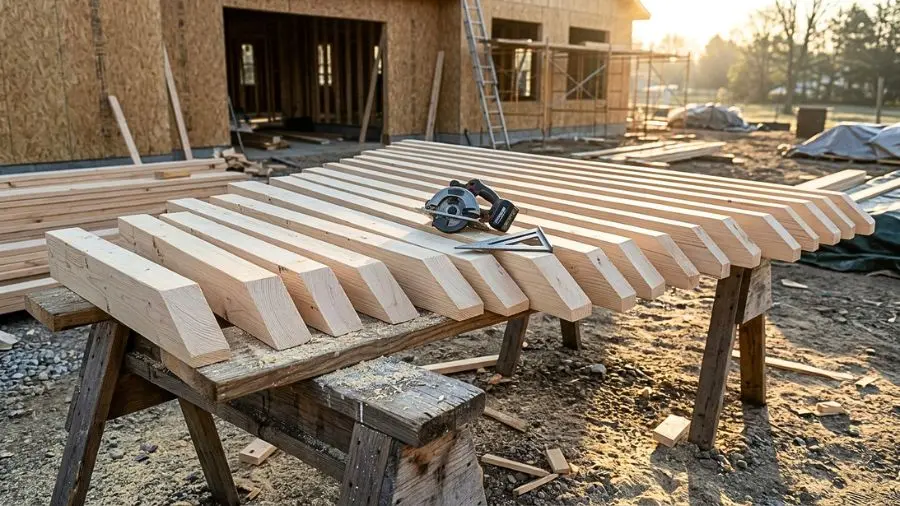
Every consecutive hip or valley jack rafter shortens by an exact mathematical increment called the Common Difference—mastering cheek cuts eliminates expensive trial-and-error lumber waste.
Nothing separates an amateur framer from a master roof cutter faster than a complex hip-and-valley roof framing package. While common rafters are identical and can be mass-cut on sawhorses, Jack Rafters (rafters that terminate against an angled hip or valley rafter rather than the ridge board or wall plate) decrease in length step-by-step. Without mathematical precision, cutting jacks turns into a frustrating graveyard of wasted 2x6 lumber.
1. The Geometry of Jack Rafters (Hip vs. Valley)
Jack rafters are categorized by where they land:
- Hip Jacks: Rest on the exterior wall top plate at the bottom (with a standard birdsmouth cut) and terminate against the hip rafter at the top with an angled cheek cut.
- Valley Jacks: Connect to the central ridge board at the top with a standard plumb cut and terminate against the valley rafter at the bottom with an angled cheek cut.
- Cripple Jacks: Connect between a hip and valley rafter, touching neither ridge nor wall plate, requiring cheek cuts at both ends.
2. Calculating Common Difference in Length
Because hip and valley rafters sit at a 45° angle in plan view, the horizontal run of each consecutive jack rafter changes by an amount exactly equal to the on-center spacing (16 inches or 24 inches). Therefore, every consecutive jack rafter changes in length by a constant mathematical increment called the Common Difference:
Common Difference = On-Center Spacing × [ √(Run² + Pitch²) / 12 ]
For a standard 6/12 roof pitch with rafters spaced at 16" on center:
Unit Length = √(12² + 6²) = √(144 + 36) = 13.416 inches
Common Difference = 16 × (13.416 / 12) = 17.888 inches ≈ 17-7/8"
If your longest jack rafter measures 10'-4", the second jack is precisely 10'-4" - 1'-5 7/8" = 8'-10 1/8", the third is 7'-4 1/4", and so on. You can pre-cut the entire set on the ground before ever climbing a ladder!
3. Marking and Cutting the 45° Cheek Bevel Cut
Where a jack rafter meets the hip or valley member, it cannot be cut square. It requires a compound cut called a Cheek Cut (or side bevel):
- Mark the Plumb Line: Set your speed square to the common pitch (e.g., 6 on the Common scale) and scribe a vertical plumb line across the face of the 2x6.
- Tilt the Circular Saw Base: Tilt your circular saw base plate to 45 degrees.
- Cut Along the Plumb Line: Guide the blade down the plumb line. The combination of the vertical angle on the face and the 45-degree blade tilt produces the compound cheek angle that mates flat against the 1-1/2" side face of the hip or valley rafter.
- Cheek Orientation: Remember that jacks mate in pairs—one left-hand cheek cut and one right-hand cheek cut for opposite sides of the hip timber!
4. Accounting for Rafter Thickness Deductions
Remember that the hip rafter has a finite physical thickness (typically 1-1/2" for dimensional lumber or 1-3/4" for LVL). When measuring jack rafter length to the theoretical center line of the hip, you must deduct half the 45° thickness of the hip timber (3/4" × 1.414 = 1-1/16") from the theoretical measurement to prevent the jack from pushing the hip out of straight line alignment.
Never wrestle with complex trigonometric fractions or convert decimals on scrap 2x4s with a dull pencil. Use Framing & Roof Calc: Tape 1/16 to instantly generate complete jack rafter cut lists, pitch multipliers, and exact 1/16-inch tape measure fractions on site.
🪚 Live Field Estimator: Common Rafter Pitch & IRC Stair Code
Trigonometric BlueprintTest roof rafters and stair stringers with instant building code validation:
Stair IRC Code Check: 9 Risers @ 7-3/4" — ✅ PASSES IRC R311.7.5 CODE (≤7-3/4")
Framing & Roof Calc: Tape 1/16
Job-site engineering instrument with dual units (US Imperial fractions ↔ Metric). Features visual 1/16" tape zoom with red needle, 1-tap fractions, voice readout on ladders, roof pitch & rafters (Common, Hip/Valley, Jack), IRC stair stringers, raked wall studs, and concrete cubic yards.
✓ Free on Android (Google Play) • ✓ Works 100% Offline • ✓ 0% Crashes
Frequently Asked Technical Question
What is the formula to calculate the Common Difference in length between consecutive jack rafters?
The Common Difference is the constant length increment by which each consecutive jack rafter shortens. The formula is: Common Difference = On-Center Spacing x (Hypotenuse Factor of the Pitch). For a 6/12 pitch (hypotenuse = 13.416 inches per 12 inches of run) with rafters spaced 16 inches on center, Common Difference = 16 x (13.416 / 12) = 17.89 inches (approx. 17-7/8 inches). Once you cut the first jack, each subsequent rafter is exactly 17-7/8 inches shorter.