Aluminum vs. Copper Feeder Wiring: Preventing Galvanic Meltdowns & Ampacity Upsizing
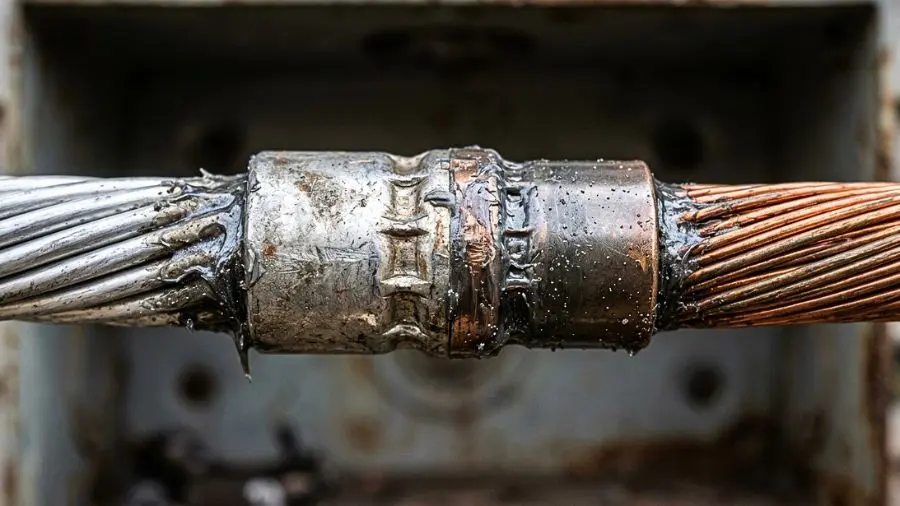
Connecting bare copper and aluminum directly accelerates moisture-driven galvanic corrosion unless dual-rated AL7CU/AL9CU lugs and antioxidant paste isolate the metals.
With copper prices climbing relentlessly, switching main service entrances and 100-Amp detached workshop subpanels to aluminum SER or MHF feeders often cuts cable material budgets by 50% to 65%. Yet thousands of electricians refuse to touch aluminum because of terrifying house fires from the late 1960s and 1970s. Engineering codes separated fact from myth decades ago—provided you follow three strict metallurgical rules.
1. Why Legacy 1960s Aluminum Failed vs. Modern AA-8000 Alloy
Early residential aluminum used utility-grade 1350 pure aluminum, which suffered severe thermal creep (cold flow). Every time a hair dryer warmed the terminal, the metal expanded slightly more than steel screws, gradually squeezing out soft metal until it cooled loose and sparked. Today's AA-8000 series aluminum alloy dramatically lowers creep—but still oxidizes instantaneously when scratched in open air.
2. Three Mandatory Rules for Bulletproof Aluminum Feeders
- Step Up Resistivity Math: Because aluminum resistivity sits ~64% higher than copper, you cannot guess sizes from memory. Select Aluminum in multi-metal calculators to automatically account for higher resistance (
ρ = 0.0282) and voltage drop over long trench runs. - Torque Screwdriver Discipline: Tightening main lugs purely "by wrist feel" crushes soft aluminum strands or leaves micro-gaps. Always calibrate to the exact inch-pound or Nm torque stamped on the breaker chassis.
- Never Mix Metals Without Bimetallic Separation: Direct copper-to-aluminum contact forms a galvanic battery in humid air, rapidly forming resistive white aluminum oxide crust. Use only AL7CU or AL9CU tin-plated compression lugs coated with zinc-suspended anti-oxidant compound.
⚡ Live Interactive Mini-Calculator: Voltage Drop & Joule Heat
Ohm's Law EngineTest conductor resistance (R = ρ·L/A) and see heat wasted in the cable before installation:
Joule Heat Loss in Cable: 157.5 Watts
Wire Size & Voltage Drop Calc
Stop testing wire gauges one by one! Automatically calculates commercial AWG & metric mm² sizes, breaker trip ratings (Ib ≤ In ≤ Iz), 8 conductor metals (Copper, Aluminum, Pure Nickel, Nichrome), AC Mains, 12V/24V/48V Solar, 40% Conduit Fill, and 40 Offline Guides.
✓ Free on Android (Google Play) • ✓ Works 100% Offline • ✓ 0% Crashes
Frequently Asked Technical Question
Why does aluminum wiring require two AWG sizes thicker than copper for the same amperage?
Aluminum has roughly 61% the electrical conductivity of copper (higher specific resistivity: ~0.0282 vs 0.0172 ohm-mm2/m). To safely carry identical 100A subpanel current without overheating, NEC tables step up roughly two AWG gauges (such as 2 AWG aluminum instead of 3 or 4 AWG copper).