Wire Ferrules vs. Bare Stranded Wire: The Mechanical Reason Screw Terminals Catch Fire
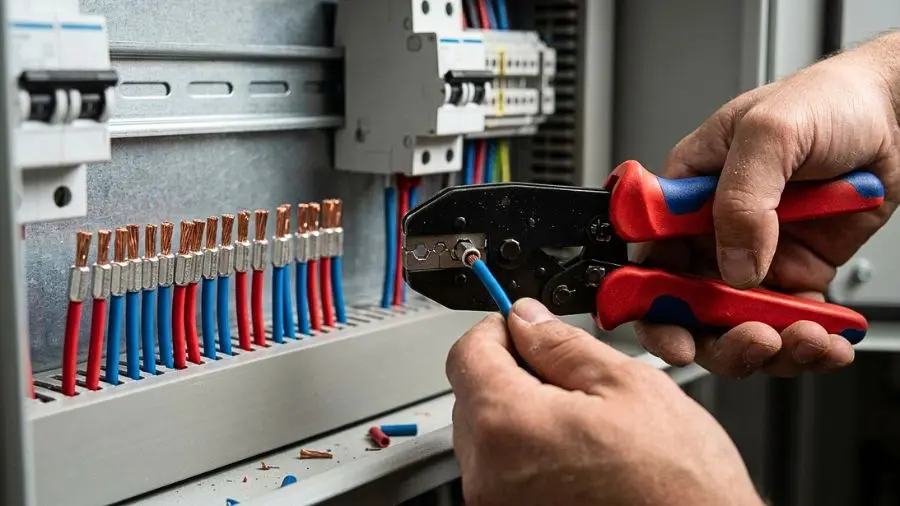
Directly clamping fine-stranded copper under a terminal screw cuts individual strands and induces copper creep—crimped DIN 46228 bootlace ferrules eliminate thermal runaway fires.
If you inspect burned circuit breaker panels, solar inverter DC inputs, or industrial machinery cabinets, one failure mode appears with alarming regularity: a charred terminal block with an intact wire still sitting inside the melted lug. The electrician swears the screw was torqued tightly on day one. So why did it burst into flames months later? The answer lies in the microscopic physics of Bare Stranded Copper under Compression.
1. The Anatomy of Terminal Screw Failure
Flexible building wire (Class 5 and Class 6 fine stranded conductors) consists of dozens of hair-thin copper strands. When shoved bare under a rotating terminal screw:
- Mechanical Shearing: The rotating metal screw acts like a milling cutter, shearing through 15% to 30% of the outer strands as torque is applied. This instantly downgrades the effective wire cross-section.
- Stray Hair Flashovers: Unconfined fine strands splay outwards. A single loose copper strand escaping the terminal barrier can touch an adjacent pole or metal chassis, causing a catastrophic short-circuit flashover.
- Thermal Creep (Cold Flow): Copper is a ductile metal. Under constant mechanical pressure and alternating thermal expansion cycles (load heating and nighttime cooling), unconstrained copper strands slowly migrate laterally into vacant pocket spaces. The clamping screw loses preload tension.
2. The Thermal Runaway Spiral (P = I² × R)
The instant screw clamping pressure relaxes, the effective electrical contact surface area shrinks to microscopic contact asperities. Contact resistance (R_contact) spikes from milliohms to ohms:
Under a 20A load, a mere 0.5 Ω contact resistance generates: P = (20A)² × 0.5 Ω = 200 Watts of concentrated heat inside a space the size of a fingernail. That localized heat rapidly oxidizes the copper, increasing resistance further until plastic DIN-rail enclosures melt and ignite.
3. DIN 46228 Standards for Bootlace Ferrules
A wire ferrule (bootlace ferrule) is a thin-walled, tin-plated electrolytic copper tube with a flared polypropylene insulation collar, governed by the German standard DIN 46228 (Parts 1 to 4):
- Gas-Tight Cold Weld: When crimped with a proper 4-mandrel or 6-mandrel ratcheting tool, the loose copper strands and tin sleeve are compressed into a dense, trapezoidal or hexagonal solid pin with zero air pockets.
- Uniform Force Distribution: The terminal screw presses down onto a hardened, flat tinned surface. Clamping force is distributed evenly across 100% of the internal copper strands without slicing a single wire.
- Corrosion Resistance: By excluding atmospheric oxygen and humidity from the strand core, galvanic oxidation and fretting corrosion are permanently stopped.
4. Professional Crimping Rules
Never solder stranded wire tips before inserting them into screw terminals! Solder (tin-lead or lead-free) exhibits extreme cold flow under pressure and melts at relatively low temperatures, virtually guaranteeing loose connections. Always strip to the exact sleeve length, verify that no copper extends beyond the plastic collar, and crimp with a calibrated ratcheting mechanism.
Accurate electrical installations start with matching the correct terminal rating to conductor cross-sections. Use Wire Size & Voltage Drop Calc to verify current densities, conversion between AWG and metric mm², and breaker compatibility across all control panels.
⚡ Live Interactive Mini-Calculator: Voltage Drop & Joule Heat
Ohm's Law EngineTest conductor resistance (R = ρ·L/A) and see heat wasted in the cable before installation:
Joule Heat Loss in Cable: 157.5 Watts
Wire Size & Voltage Drop Calc
Stop testing wire gauges one by one! Automatically calculates commercial AWG & metric mm² sizes, breaker trip ratings (Ib ≤ In ≤ Iz), 8 conductor metals (Copper, Aluminum, Pure Nickel, Nichrome), AC Mains, 12V/24V/48V Solar, 40% Conduit Fill, and 40 Offline Guides.
✓ Free on Android (Google Play) • ✓ Works 100% Offline • ✓ 0% Crashes
Frequently Asked Technical Question
Why do screw terminals on breakers, contactors, and solar inverters loosen over time when bare stranded wire is used?
When a rotating terminal screw presses directly against bare stranded wire, it shears delicate outer strands and leaves uneven microscopic contact points. Over operational heating and cooling cycles, unconfined copper undergoes mechanical 'creep' (cold flow), relaxing clamping tension. The resulting high contact resistance generates localized heat (P = I² × R), which accelerates oxidation and creates a thermal runaway fire hazard.