Sizing Nichrome 80/20 Wire: Hot-Wire Foam Cutters, Resistive Coils & Thermal Math
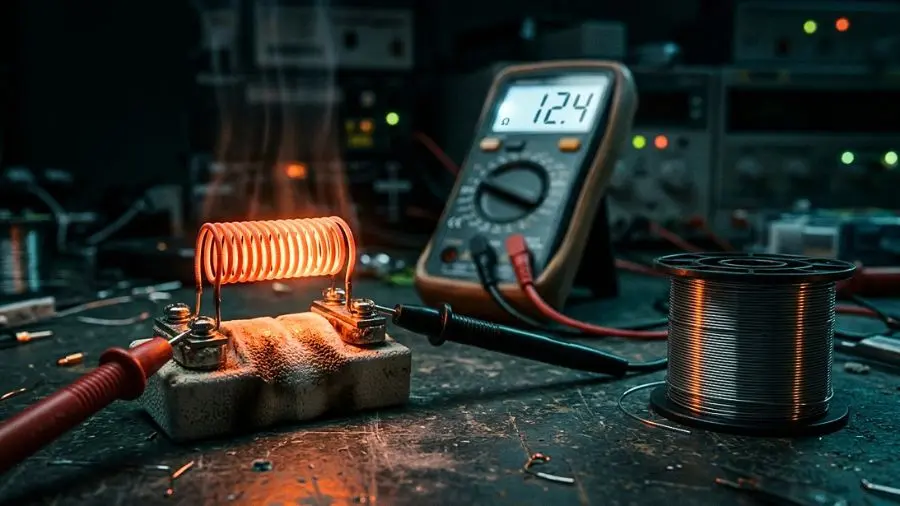
Unlike copper wiring designed to stay cool, Nickel-Chromium (NiCr 80/20) harnesses high controlled resistivity (~1.08 Ω·mm²/m) to turn clean Watts into radiant heat.
Nearly all electrical wire sizing tutorials try to eliminate resistance and wasted Watts. Yet when engineers build DIY EPS architectural foam cutters, incubator coils, heated mirrors, or battery discharge test banks, controlled Joule heat (P = I² × R) is literally the entire objective.
1. Why Nichrome 80/20 Beats Steel, Iron & Copper for Heat
Nichrome (80% Nickel, 20% Chromium) possesses roughly 63 times higher resistivity than pure copper (1.08–1.12 Ω·mm²/m vs. copper's 0.0172), refuses to flake with heavy oxidation up to 1,200 °C (thanks to an invisible chromium oxide protective shell), and exhibits negligible resistance drift between room temperature and red glow.
2. Step-by-Step Sizing for a Clean 36-Inch Foam Bow
- Determine Target Power Per Meter: To glide smoothly through expanded polystyrene foam without melting giant cavities, target ~200–300 °C along a wire pulling around
35 to 45 Wattsper meter of cut span. - Solve Required Target Resistance: Using a common 24V 5A DC laptop brick (max safe continuous current ~4.0A), target resistance via
R = V / I = 24V / 3.5A ≈ 6.86 Ohmstotal. - Verify Specific Alloy Gauge: A 26 AWG (
~0.129 mm²) Nichrome 80 strand delivers ~8.4 Ohms/meter, giving exact smooth cutting tension on a 32-inch frame with zero power-supply overload!
You don't need spreadsheet guesswork: open the 8-Metal Selector inside Wire Size & Voltage Drop Calc, switch conductor material to Nichrome, input length and diameter, and observe exact cold/hot Ohms and dissipated Watts immediately.
⚡ Live Interactive Mini-Calculator: Voltage Drop & Joule Heat
Ohm's Law EngineTest conductor resistance (R = ρ·L/A) and see heat wasted in the cable before installation:
Joule Heat Loss in Cable: 157.5 Watts
Wire Size & Voltage Drop Calc
Stop testing wire gauges one by one! Automatically calculates commercial AWG & metric mm² sizes, breaker trip ratings (Ib ≤ In ≤ Iz), 8 conductor metals (Copper, Aluminum, Pure Nickel, Nichrome), AC Mains, 12V/24V/48V Solar, 40% Conduit Fill, and 40 Offline Guides.
✓ Free on Android (Google Play) • ✓ Works 100% Offline • ✓ 0% Crashes
Frequently Asked Technical Question
Why can't you just power a short strand of Nichrome wire straight from a 12V car battery?
If a short, thick piece of Nichrome measures only 0.2 Ohms across 12.6 Volts, Ohm's Law (I = V / R) drives 63 Amps and nearly 800 Watts into a tiny metal strand—instantly glowing white-hot and snapping cleanly in under two seconds before a standard 20A bench fuse can save your setup.