The Open Neutral Nightmare: Why One Broken Return Wire Sends 200V Through 120V Outlets
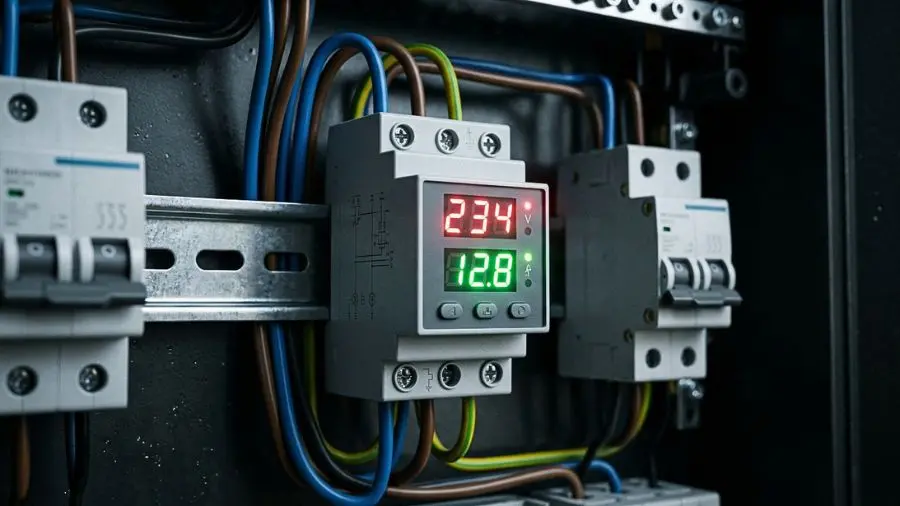
In split-phase 120V/240V or 3-phase 230V/400V networks, losing the neutral turns household outlets into an unbalanced series voltage divider.
Every licensed troubleshooter knows the unmistakable dread of this homeowner call: "Half my LED lights just flared blindingly bright and popped, while the microwave slowed to a crawl and my toaster smells weird." Before anyone replaces another appliance, kill the main breaker immediately—you likely have a Broken or Corroded Neutral Conductor.
1. Ohm's Law Voltage Divider Across Two Legs
North American homes run on 120V / 240V Split-Phase systems (while international installations run 230V / 400V 3-Phase Wye). Under normal operation, the white/blue Neutral wire acts as the rigid zero-volt anchor keeping Leg A at 120V and Leg B at 120V.
The instant wind snaps the utility service neutral splice or corrosion loosens the main panel neutral screw, both hot legs remain connected in series across 240V total, bridged exclusively through whatever household plugs happen to be powered on!
- Suppose a 1,500W space heater (low electrical resistance) sits plugged into Leg A, while your 15W Wi-Fi router & OLED TV (high resistance) sit on Leg B.
- By series resistance ratios, the heavy heater hogs minimal voltage (~35V) while starving cold—leaving the remaining ~205 Volts of the 240V differential slamming straight into your delicate 120V TV power supply!
2. Preventing Catastrophic Motor & Board Failures
Undersize or overloaded shared neutral conductors (Multi-Wire Branch Circuits sharing one neutral without phase balance) overheat silently behind drywall. Use balanced-phase sizing checks in Wire Size & Voltage Drop Calc and consider installing DIN-rail programmable over/undervoltage protective relays on sensitive refrigerator and workshop circuits.
⚡ Live Interactive Mini-Calculator: Voltage Drop & Joule Heat
Ohm's Law EngineTest conductor resistance (R = ρ·L/A) and see heat wasted in the cable before installation:
Joule Heat Loss in Cable: 157.5 Watts
Wire Size & Voltage Drop Calc
Stop testing wire gauges one by one! Automatically calculates commercial AWG & metric mm² sizes, breaker trip ratings (Ib ≤ In ≤ Iz), 8 conductor metals (Copper, Aluminum, Pure Nickel, Nichrome), AC Mains, 12V/24V/48V Solar, 40% Conduit Fill, and 40 Offline Guides.
✓ Free on Android (Google Play) • ✓ Works 100% Offline • ✓ 0% Crashes
Frequently Asked Technical Question
What causes household outlets to swing wildly between 50V and 200V when heavy appliances turn on?
That erratic voltage seesaw is the textbook warning of an Open or High-Resistance Neutral on the main service feed. Because the two opposite hot legs can no longer return current independently to the transformer center-tap, 120V circuits get forced in series across 240V, shifting voltage heavily toward whichever leg has fewer watts running.