Euro 6 Smart Alternators: Why Simple Battery Isolators Starve Camper & Work-Truck Lithium Banks
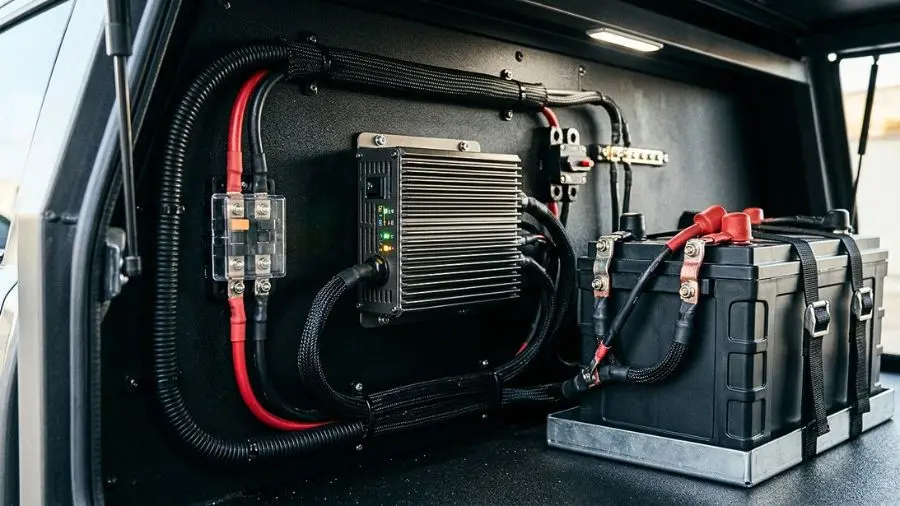
Modern ECU-controlled smart alternators cut field voltage down to ~12.4V–12.7V while cruising to save fuel, making standard VSR relays disconnect halfway through drives.
Twenty years ago, charging a secondary deep-cycle house battery while driving required nothing more than a $40 Voltage Sensitive Relay (VSR) bridged between your starter battery and auxiliary bank. Today, on post-2016 pickups, Transit/Sprinter vans, and Euro 5/Euro 6 diesel trucks, that classic relay leaves travelers waking up with dead refrigerators after six hours of highway driving.
1. The Fuel-Economy Sabotage Inside Your ECU
To shave fleet emissions, engine computers actively decouple alternator drag once your starter battery tops off. While you cruise down the interstate at 65 mph, your "smart" alternator intentionally lowers bus voltage to 12.5V–12.7V, only spiking to 14.8V during coasting and regenerative deceleration. A VSR waiting for 13.3V assumes the engine shut off and instantly disconnects your camper bank!
2. Why Lithium Banks Destroy Unregulated Alternators
Switching to a direct manual switch creates the opposite nightmare. LiFePO4 internal impedance is tiny; a 300Ah lithium pack sitting at 30% state of charge will greedily suck 120+ Amps non-stop at stoplights when alternator cooling fans spin slowly—baking stator diodes quickly.
3. Sizing Cable Runs for Isolated & Non-Isolated DC-DC Chargers
A DC-DC Battery Charger (30A, 50A, or 60A) acts as both an ignition-triggered voltage booster (turning 12.2V highway droop into clean 14.4V multi-stage lithium bulk/absorption power) and a strict current governor protecting the alternator. Remember that round-trip engine-bay to rear-garage cable length counts both positive and negative paths! Keep 12V DC line losses under 2% using Wire Size & Voltage Drop Calc so your booster doesn't trigger low-input shutdown.
⚡ Live Interactive Mini-Calculator: Voltage Drop & Joule Heat
Ohm's Law EngineTest conductor resistance (R = ρ·L/A) and see heat wasted in the cable before installation:
Joule Heat Loss in Cable: 157.5 Watts
Wire Size & Voltage Drop Calc
Stop testing wire gauges one by one! Automatically calculates commercial AWG & metric mm² sizes, breaker trip ratings (Ib ≤ In ≤ Iz), 8 conductor metals (Copper, Aluminum, Pure Nickel, Nichrome), AC Mains, 12V/24V/48V Solar, 40% Conduit Fill, and 40 Offline Guides.
✓ Free on Android (Google Play) • ✓ Works 100% Offline • ✓ 0% Crashes
Frequently Asked Technical Question
Why does connecting a LiFePO4 battery directly to a vehicle alternator risk burning out the alternator?
Lithium iron phosphate (LiFePO4) cells exhibit extremely low internal resistance and act like a massive electrical vacuum. While lead-acid starter batteries naturally limit incoming amps as their surface voltage rises, a depleted LiFePO4 bank can pull 100% of the alternator's maximum cold-rated output continuously at idle, overheating copper stator windings within minutes.