Deep Borehole Well Pump Wiring: Why Voltage Drop Slashes Motor Starting Torque Squared
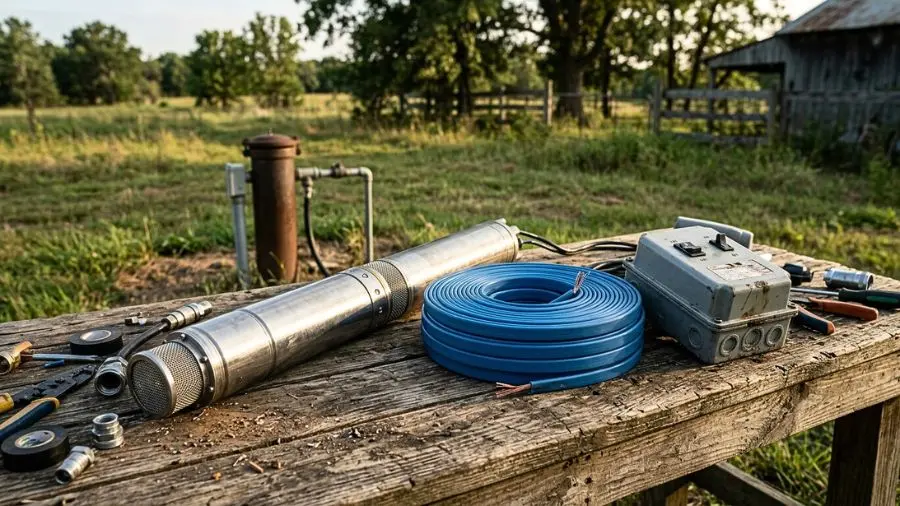
Submersible pump runs combine surface trench distance PLUS vertical borehole depth—forcing massive motor starting voltage sag unless upsized properly.
Submersible deep-well pumps endure the toughest electrical environment on any rural property: suspended 300 feet underwater inside cramped casings, starting against heavy water-column head pressure, at the far tail end of long agricultural wire runs. When installers forget to include vertical submergence depth in their wire calculation, pumps burn up windings underground—costing thousands in crane pulling bills.
1. The Brutal V² Motor Torque Penalty
Locked-rotor starting torque in induction pump motors scales roughly with the square of terminal voltage. If an under-gauged wire drops 12% of line voltage the instant the pressure switch clicks closed (240V → 211V), your pump doesn't just lose 12% twist—it loses ~23% of starting breakaway torque!
Sluggish spinning prevents centrifugal start switches from disengaging start capacitors promptly, cooking enameled copper coils submerged out of sight.
2. Don't Forget Total Two-Segment Path & Waterproof Joints
- Measure Surface + Submergence Together: Input total one-way distance from main panel all the way to pump depth inside Wire Size & Voltage Drop Calc (keeping voltage drop strictly under 2–3% at locked-rotor / service-factor amperage).
- Step Up 240V Instead of 120V Over 100 Feet: Doubling operating voltage halves load amps and quarters cable cross-section expense immediately.
- Stagger Underwater Crimps & Dual-Wall Heat Shrink: Never twist wire nuts underwater! Stagger adhesive-lined marine butt splices by 2 inches each so splices stay slim inside well casings with triple moisture protection.
⚡ Live Interactive Mini-Calculator: Voltage Drop & Joule Heat
Ohm's Law EngineTest conductor resistance (R = ρ·L/A) and see heat wasted in the cable before installation:
Joule Heat Loss in Cable: 157.5 Watts
Wire Size & Voltage Drop Calc
Stop testing wire gauges one by one! Automatically calculates commercial AWG & metric mm² sizes, breaker trip ratings (Ib ≤ In ≤ Iz), 8 conductor metals (Copper, Aluminum, Pure Nickel, Nichrome), AC Mains, 12V/24V/48V Solar, 40% Conduit Fill, and 40 Offline Guides.
✓ Free on Android (Google Play) • ✓ Works 100% Offline • ✓ 0% Crashes
Frequently Asked Technical Question
Why must you add both horizontal trench distance and vertical well depth when sizing submersible pump wire?
Electricity doesn't care whether wire lies horizontally underground or drops vertically down a steel casing—every foot adds conductor resistance. A well located 150 ft from the barn with a pump hanging 250 ft deep equals a 400-foot one-way circuit (800 ft total copper path!).