Motor Circuit Protection: Sizing MPCBs, Contactors & Thermal Overload Relays (NEC 430)
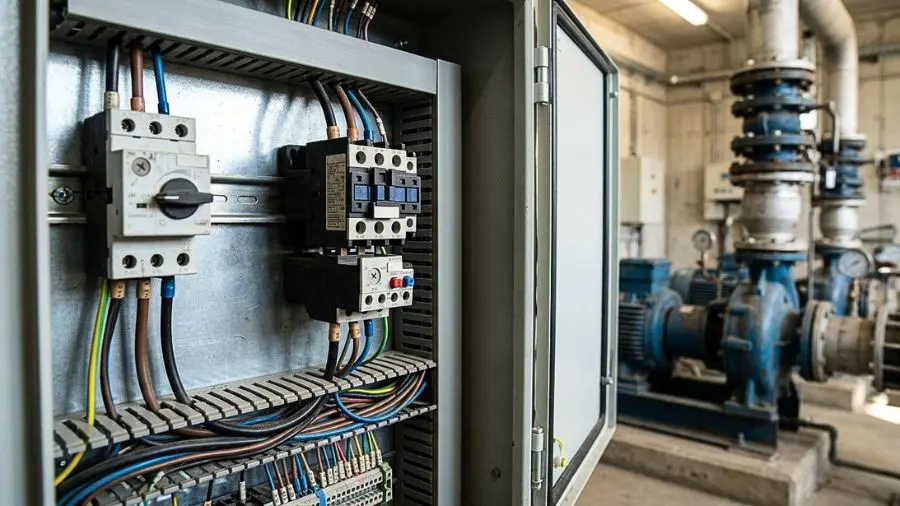
Because circuit breakers feeding electric motors are oversized up to 250% to withstand locked-rotor starting surges, dedicated thermal overload relays are required to prevent motor burnout.
Protecting an electric induction motor presents one of the most unique challenges in electrical engineering. If you size a circuit breaker tightly to the motor's operating current, the breaker will nuisance-trip the split-second the motor starts. But if you oversize the breaker to clear starting surges, the motor can silently overheat, seize its bearings, and burn out its copper windings without the breaker ever noticing.
1. The Inrush Surge Dilemma (FLA vs. LRA)
When an AC squirrel-cage induction motor is stationary at zero RPM and energized across-the-line, there is zero counter-electromotive force (CEMF). The stator winding acts as a direct transformer short circuit to the rotor bars:
- Full Load Amps (FLA): The continuous current drawn by the motor when delivering its rated mechanical shaft horsepower at rated voltage.
- Locked Rotor Amps (LRA): The violent initial current surge—typically 6× to 8× FLA—lasting from 0.5 to 5 seconds until the rotor accelerates up to base speed.
2. Branch Circuit Short-Circuit Protection (NEC 430.52)
To keep the branch breaker from tripping during inrush, NEC Table 430.52 allows the upstream Short-Circuit and Ground-Fault Protective Device (SCGFPD) to be rated far above the motor's normal capacity:
| Protective Device Type | Max Setting (% of Motor FLA) |
|---|---|
| Inverse Time Circuit Breaker (Standard Thermal-Magnetic) | 250% (can increase to 400% for high-inertia loads) |
| Non-Time Delay Fuses | 300% |
| Dual-Element Time-Delay Fuses | 175% |
Because a 20A motor may have a 50A breaker upstream, that breaker is incapable of detecting low-level overcurrents like a jammed conveyor or worn pump impeller.
3. Dedicated Overload Protection: Relays and MPCBs
Under NEC 430.32, motors must be paired with dedicated overload protection that tracks the motor's actual thermal heating curve:
- Bimetallic Thermal Overload Relays: Mounted directly to the load terminals of an electromagnetic contactor. The dial must be set strictly to the motor's nameplate FLA × 1.0 to 1.15 (depending on motor service factor). Trip class (Class 10 vs Class 20) dictates trip time in seconds under 600% locked-rotor conditions.
- Motor Protection Circuit Breakers (MPCBs / Guardamotores): Combine thermal overload dial adjustment, magnetic short-circuit clearing, and built-in differential Single-Phasing Protection (tripping instantly if one phase fuse blows, preventing devastating motor single-phasing burnouts).
4. Contactor Ratings: AC-1 vs. AC-3
Never size motor contactors based on their general resistive nameplate rating! An AC-1 rated contactor is meant for non-inductive heaters. Electric motors mandate AC-3 Duty Ratings (squirrel-cage starting and switching off while running) or AC-4 Duty (plugging and inching), featuring heavy silver-alloy contact tips designed to quench breaking arcs.
When engineering motor branch circuits, wire feeders, and breaker selections according to international standards, use Wire Size & Voltage Drop Calc to verify voltage drop during high-surge starts and ensure absolute code compliance.
⚡ Live Interactive Mini-Calculator: Voltage Drop & Joule Heat
Ohm's Law EngineTest conductor resistance (R = ρ·L/A) and see heat wasted in the cable before installation:
Joule Heat Loss in Cable: 157.5 Watts
Wire Size & Voltage Drop Calc
Stop testing wire gauges one by one! Automatically calculates commercial AWG & metric mm² sizes, breaker trip ratings (Ib ≤ In ≤ Iz), 8 conductor metals (Copper, Aluminum, Pure Nickel, Nichrome), AC Mains, 12V/24V/48V Solar, 40% Conduit Fill, and 40 Offline Guides.
✓ Free on Android (Google Play) • ✓ Works 100% Offline • ✓ 0% Crashes
Frequently Asked Technical Question
Why can't a standard distribution circuit breaker provide overload protection for an industrial electric motor?
When starting across the line, AC induction motors draw Locked Rotor Amps (LRA) between 600% and 800% of their nameplate Full Load Amps (FLA). To prevent nuisance tripping during that 2-to-5 second start, NEC 430.52 allows upstream breakers to be oversized up to 250% of motor FLA. Because that breaker is sized so high, it will never trip if the motor runs continuously at 120% load or loses a single phase—requiring a dedicated thermal overload relay or MPCB set precisely at 100% to 115% FLA.