Type B, C & D Breaker Trip Curves: Why Motors Nuisance-Trip Correct Amperage Breakers
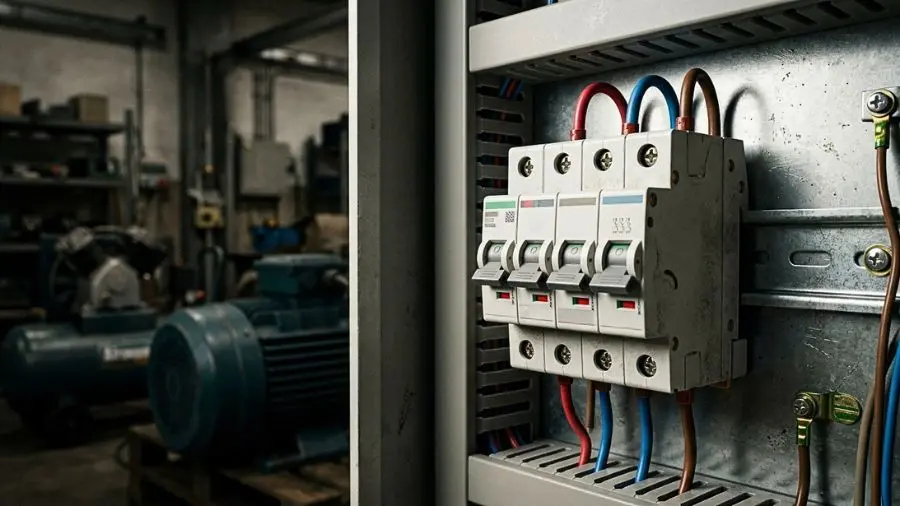
Magnetic instant-trip thresholds differentiate Curve B (3–5x In), Curve C (5–10x In), and Curve D (10–20x In) to handle heavy inductive startup surges safely.
Picture this frustrating job-site scene: you wire a dedicated circuit for a 1.5 HP workshop dust collector drawing 11 Amps steady, protected cleanly by 12 AWG copper and a fresh 16-Amp breaker. You press the green start button, and CLACK!—the breaker snaps shut instantaneously before the motor finishes its first revolution.
Many amateurs immediately make a fatal code violation: swapping in a 25A or 32A breaker. That protects nothing—your cable becomes the fuse. The real answer lies inside the dual-trigger anatomy of every miniature circuit breaker.
1. Two Separate Trip Mechanisms Under One Toggle
- The Thermal Bimetallic Strip (Slow Overload): Defends against gradual continuous heat (e.g., plugging two space heaters into a 15A branch). At
1.13xto1.45xrated current, the bimetal warms and unlatches safely in minutes. - The Magnetic Solenoid Coil (Instant Short-Circuit): Reacts in <10 milliseconds to sudden extreme spikes. The exact multiplier separating a normal motor start from a dead short defines the letter printed right before amperage (e.g.,
C16vsB16).
2. Choosing Curve B, C, or D (and US HACR Equivalents)
- Curve B (3× to 5× In): Trips instantly at 48–80A on a 16A breaker. Built strictly for resistive lighting, ovens, and long low-fault-current feeders. Inductive compressors will trip it instantly.
- Curve C (5× to 10× In): The commercial & residential workhorse (80–160A magnetic window for a 16A unit). Handles household refrigerators, microwaves, and medium AC blowers effortlessly.
- Curve D (10× to 20× In): Reserved for heavy transformers, welders, and deep-well pumps pulling massive locked-rotor amperage (LRA) for half a second without raising continuous thermal ceiling!
Need to confirm both steady current Ib and safe conductor thermal capacity Iz before locking in your panel? Verify exact coordination curves inside Wire Size & Voltage Drop Calc.
⚡ Live Interactive Mini-Calculator: Voltage Drop & Joule Heat
Ohm's Law EngineTest conductor resistance (R = ρ·L/A) and see heat wasted in the cable before installation:
Joule Heat Loss in Cable: 157.5 Watts
Wire Size & Voltage Drop Calc
Stop testing wire gauges one by one! Automatically calculates commercial AWG & metric mm² sizes, breaker trip ratings (Ib ≤ In ≤ Iz), 8 conductor metals (Copper, Aluminum, Pure Nickel, Nichrome), AC Mains, 12V/24V/48V Solar, 40% Conduit Fill, and 40 Offline Guides.
✓ Free on Android (Google Play) • ✓ Works 100% Offline • ✓ 0% Crashes
Frequently Asked Technical Question
Why should you change breaker curve type (e.g., Curve C to Curve D) rather than upsizing breaker amperage for motor nuisance trips?
Upsizing a 16A breaker to 25A compromises thermal protection for 14 AWG / 2.5 mm2 cable during slow overloads (violating Ib <= In <= Iz). Switching to a higher magnetic trip curve (such as Curve C or Curve D at the same 16A thermal rating) tolerates brief 100ms motor start surges while keeping long-term cable thermal protection intact.