The Ground Rod Fallacy: Why Soil Resistance Will Never Trip an Overcurrent Breaker
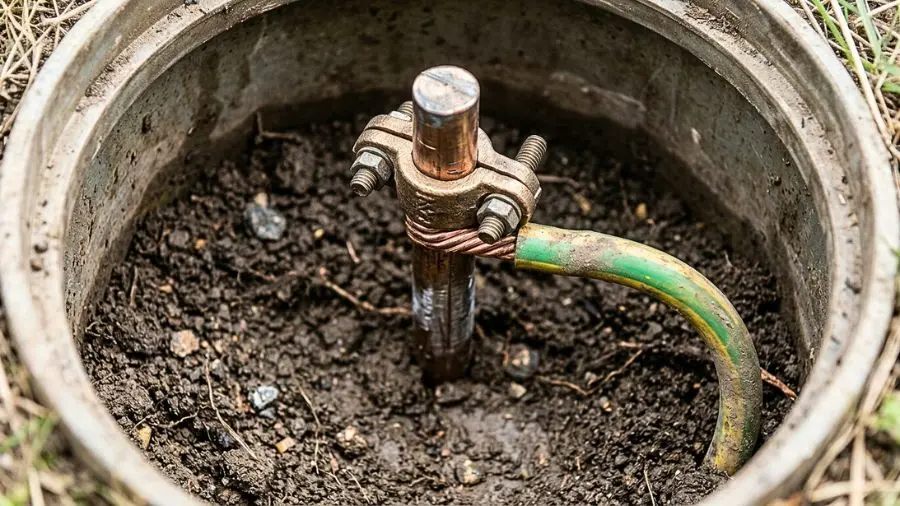
Driving a copper ground rod deep into earth provides lightning and surge dissipation, but earth resistance is far too high to clear an electrical short circuit without an equipment ground conductor.
Few concepts in building electrification are surrounded by as much folklore as the copper grounding rod driven into the backyard lawn. Millions of property owners—and surprisingly many handymen—believe that the ground rod's job is to "absorb" short circuits and trigger the circuit breaker if a live wire comes loose. In truth, relying on dirt to clear a fault is a recipe for fatal shocks and structural fires.
1. Ohm's Law and the 25-Ohm Dirt Barrier
Both NEC Article 250.53 and international wiring standards mandate that a single grounding electrode have an earth resistance of 25 Ω or less (otherwise requiring a second supplemental rod). Let us calculate what happens when a 120V live conductor shorts directly to a metal box grounded exclusively through that compliant 25-ohm rod:
I = V / R = 120V / 25 Ω = 4.8 Amperes
On a 230V European or South American supply, the current is: 230V / 25 Ω = 9.2 Amperes.
A standard 15A, 16A, or 20A circuit breaker will never trip at 4.8A or 9.2A. It sees 4.8A as an ordinary toaster or television. The earth around the rod will slowly bake dry, while the appliance enclosure remains fully energized at line potential, waiting for a human hand to complete the circuit.
2. Grounding vs. Bonding: The Life-Saving Distinction
To understand electrical safety, one must separate the two distinct grounding systems:
- Grounding (Earth Connection via Rods): Connects the system to the physical planet earth. Its sole purpose is stabilizing system voltage against high-voltage surges, lightning strikes, and line crossings on the utility grid (
NEC 250.4(A)(1)). Earth is NEVER an effective fault-current path. - Bonding (Equipment Grounding Conductor / Green Wire): A continuous, low-impedance metallic copper path linking every metal appliance chassis, outlet box, and conduit directly back to the main service panel neutral bus. Because copper impedance is negligible (
< 0.1 Ω), a phase-to-ground fault creates a massive surge of 500A to 1,000A+ for a split second, tripping the magnetic breaker in under 0.01 seconds.
3. Soil Resistivity and the Two-Rod Spacing Rule
Soil resistivity varies wildly based on geological makeup and moisture content. Solid granite has a resistivity exceeding 10,000 Ω·m, while damp organic loam sits around 30 Ω·m. In dry sand or rocky ground, a single 8-foot (2.4-meter) rod rarely achieves 25 ohms.
Under NEC 250.53(A)(2), if a single rod is not proven by a specialized three-point fall-of-potential earth tester to be below 25 ohms, a second ground rod must be added. Critical installation rule: Space the two rods at least 6 feet (1.8 m) apart—ideally twice their length (16 feet)—so their electromagnetic dissipation spheres do not overlap and compromise efficiency.
4. Safe Field Practices
Always verify continuous metallic bonding from equipment frames to your panel's neutral-ground bonding jumper. Never use rebar or water pipes as a primary ground without verifying electrical continuity past water meters.
When computing conductor ampacities and equipment grounding conductor sizes (EGC) according to breaker ratings, use Wire Size & Voltage Drop Calc to ensure your system adheres strictly to code-mandated fault-clearing standards.
⚡ Live Interactive Mini-Calculator: Voltage Drop & Joule Heat
Ohm's Law EngineTest conductor resistance (R = ρ·L/A) and see heat wasted in the cable before installation:
Joule Heat Loss in Cable: 157.5 Watts
Wire Size & Voltage Drop Calc
Stop testing wire gauges one by one! Automatically calculates commercial AWG & metric mm² sizes, breaker trip ratings (Ib ≤ In ≤ Iz), 8 conductor metals (Copper, Aluminum, Pure Nickel, Nichrome), AC Mains, 12V/24V/48V Solar, 40% Conduit Fill, and 40 Offline Guides.
✓ Free on Android (Google Play) • ✓ Works 100% Offline • ✓ 0% Crashes
Frequently Asked Technical Question
If a live hot wire contacts a metal fence or chassis grounded solely through an earth rod, why won't the breaker trip?
Because dirt is a poor electrical conductor compared to copper. Even a perfectly installed ground rod meeting the NEC 25-ohm limit will only pass 4.8 amps at 120V (120V / 25 ohms = 4.8A), or 9.2 amps at 230V. Because a 15A or 20A circuit breaker requires significantly more current to trip, the breaker remains closed indefinitely, leaving metal surfaces dangerously energized.